
MEDIA WATCH: Tribune off base on 'Dancing Lemons' editorial June 28
Editor's Note: The following letter was scheduled to be published in the July 3, 2010, edition of the Chicago Tribune and is reprinted here in full as the writer provided it to the Tribune. Other teachers responded to the 'Dancing Lemons' editorial as well, and Substance would be glad to publish your responses whether the Tribune odes or not.
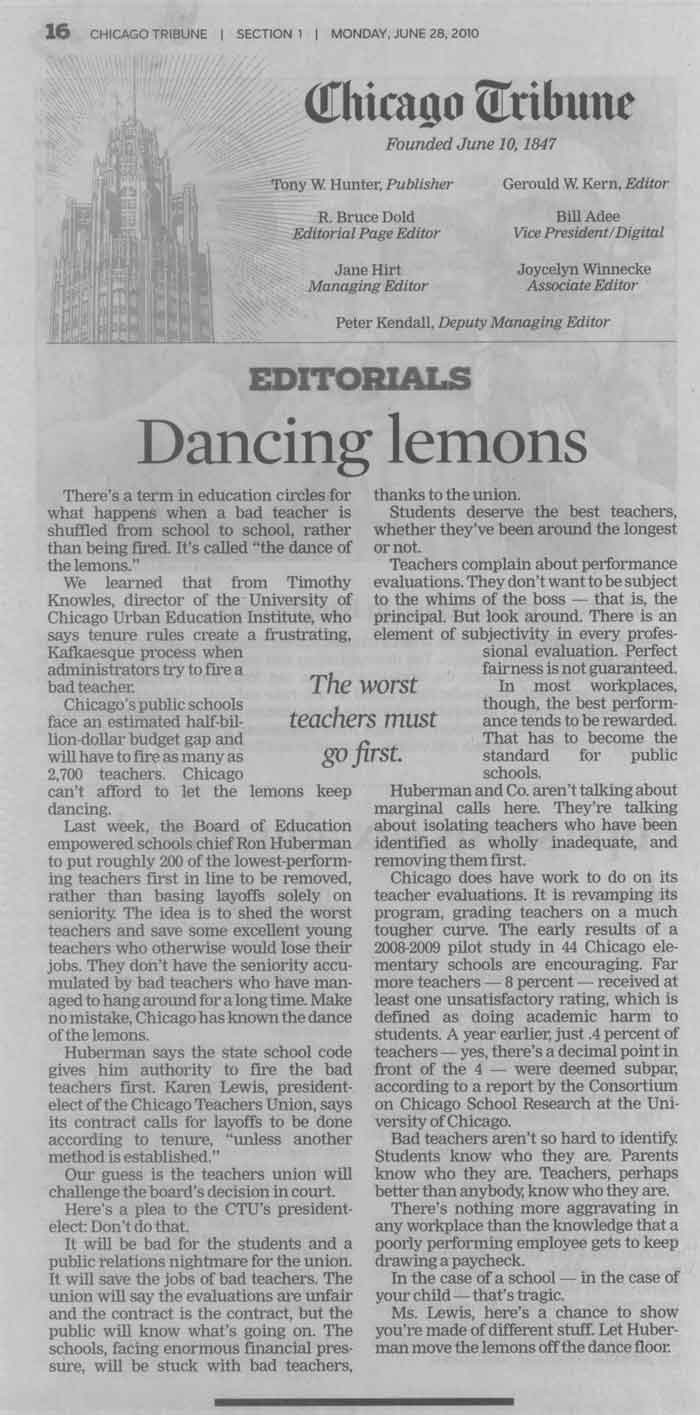 Above, the Tribune's 'Dancing Lemons' editorial of June 28, 2010, continues the Tribune's policy of doing corporate propaganda without regard to the facts. The assumption that principals should have absolute power to designate "bad teachers" has been proven over and again in history to be a flawed one, but the Tribune mindlessly repeated Ron Huberman's teacher bashing propaganda, while never criticizing the existence of Huuberman — who is completely unqualified to teacher in a classroom, let alone run the third largest school system in the USA — as 'Chief Executive Officer' of Chicago's public schools. The Tribune's hostility to public schools, public school unions, and teachers is a matter of faith, never fact.In “Dancing Lemons” (June 28,2010) the Tribune Editorial Board once again beats the drums (to continue the musical metaphor) for its favorite education reform: getting rid of bad teachers. In this case, however, the Tribune is also urging the new Chicago Teachers Union (CTU) leadership to break the law. The CTU would be criminally negligent and subject to the laws on failure to represent its members. Is the Tribune really encouraging law breaking?
The editorial also goes as far as saying that if the CTU doesn’t permit this, “the schools will be stuck with bad teachers, thanks to the union.” Perhaps a lesson in Labor Law 101 would help. It is management, not the union, which oversees the four year probationary term of new teachers, which, once completed, enables those teachers to achieve tenure, per Illinois law. CPS management has four years to assess whether a probationary teacher becomes tenured. Once tenured, this teacher can now only be dismissed for cause and with dues process.
Teacher due process rights emanate from the U.S. Constitution, which states that no state may deprive any person of life, liberty or property without due process of the law. Teacher tenure, once achieved, is a property right. And it’s a right upheld by the U.S. Supreme Court which defined teacher due process when being dismissed for cause. In Cleveland Board of Education vs. Loudermill, the Court determined that a teacher must be given oral or written notice of the dismissal, the charges and explanation of the evidence, and an opportunity for a fair and meaningful hearing. That is the legal obligation of a teacher’s bargaining unit, in this case CTU.
In addition to ensuring those due process rights are followed, the CTU contract also includes language on the “Remediation/Dismissal of Unsatisfactory Tenured Teachers”. This language includes the reasonable provision of a notice with reasons for a tenured teacher’s unsatisfactory performance after a principal has observed such performance at least twice. The teacher must then participate in a remediation plan, with support from a master teacher and the principal then evaluates said teacher every 30 days. If the teacher successfully completes the plan, then he or she is returned to annual evaluations. If not, the principal can go forward with dismissal proceedings.
Rather than viewing struggling teachers as akin to a faulty car i.e. a lemon, the law and the contract which was agreed to by the union and CPS (and specifies layoffs by seniority), requires looking at them as human beings who not only have due process and property rights, but a right to help and support to improve their performance.
In my experience, too many principals grumbled about how hard it was to “get rid of a teacher”, but too few actually provided the support necessary or bite the bullet and actually began the dismissal procedure. It was easier to complain or try to make their lives miserable so they would change schools. The Tribune should go after management not the union when it comes to addressing unsatisfactory teaching, not the union. How many principals have had teachers on remediation plans and how many teachers were able to improve? The union must do its job in enforcing those due process rights. It’s the law and the members deserve its protection.
Deborah Lynch is a teacher at Gage Park High School in Chicago and past president of the CTU (2001-2004).
Comments:
By: Jean Schwab
Dancing
Most teachers would not survive long as a "Dancing Lemon." That would be very stressful and the teacher would need the helpful quality of flexability to survive. Principals use the "Dancing Lemon method" when moving teachers often from classrooms and assignments hoping that the teacher will become stressed out and quit. dI've noticed that this happens to teachers that are outspoken and do not get a long with the principal's methods of running the school. Whistle blowers are not protected either. In a very few cases it will be used with teachers that the Principal does not agree with their teaching practices. These teachers are also given the students with the most problems so the students have a lot to be contend with. The result is that the students and their families are the ones that pay the price for these popular methods among some Principals.
Since the "Lemon" approach is so popular,I would guess that most prinipals being terminated now are the honest and capable ones.
By: Margaret Wilson
Dancing Lemons?
Teachers are not lemons. Yes, there are bad teachers who do not care about the students and can be very cruel but they are few and far between. Most teachers are dedicated and care about their students and the families. They spend a great deal of their own money for supplies, for food, and for incentives so that the children can learn and are motivated to learn. The vast majority of teachers come in early and stay late. They work with children during their own time when necessary and very few will say no to a family in need.
Most teachers that are ineffective can be helped and should be helped so they become effective teachers.
By: bob
tenure
Tenure
Any principal can get rid of any teacher any time they want. I have commented
On this last year but it might be worth re-hashing.
Principals have numerous ways to fire a teacher. Some legal, some sneaky
and some downright dirty.
The legal E3 way has not been popular for a while now because since 95
The principal picks the staff .It means an admission that a mistake was made by
some principal in the first place. Veteran teachers with over 15 years in the same school
know how to fight back and are hard targets for the E3 process because they understand
how to make principals dot the eyes and cross the tees.
Here are some examples I have run across in my 41 years of service of how
Principals have gone the sneaky or dirty route to get rid of a teacher they do not want.
Change the class from say trade electric to electronics. This would force the trade teacher
to get a college degree in 3 months, or be unqualified to teach the class.
Take consumer education and put it into the business department thus leaving the
targeted social history teacher with no program.
Put every bum in the school into the classes of a teacher and let nature take
its course. That is just a few of the games they play.
I have to wonder why no one on this blog has mentioned the rotten teachers who
are untouchable. I am talking about the clout heavy individuals who infest
the “ safe” schools. It might be a alderman’s niece, or a judges wife. These
teachers always get what they want. The bottom line is that the Board it part
By: bob
last
Sorry the last line is:
of the city where who you know trumps
what you know
By: stanley livingston
You know some should get canned
Can't deny it. You know half those teachers hired in the 90's and 80's can't organize a coherent lesson, let alone properly assess. I bet the majority of teachers in CPS have no standards based training.
By: Margaret Wilson
Re: You know some should be canned
When I read your tag, I was prepared to agree with you. Yes, there are some teachers who should be canned like those who abuse their students verbally or physically but they are a small percentage of teachers (I'd say less than 1%). However, your totally unsubstantiated claim that half of the teachers hired in the 90s and 80s can't organize a coherent lesson shows ignorance and prejudice on your part. If the majority of teachers in CPS have no standards based training (which is not true because I was in several workshops before I retired), the fault lies with the school administration, the Board, and the State who should be providing inservices and training. Teachers are required to get continuing hours to keep their certification and most schools provide some of the training in the building so they could get people to provide instruction. One of the first things I learned back in the 60s and 70s when I was getting my degree is that you need to watch out for people who quote high figures and use statements like half and majority because they are usually wrong. In a true/false test, I teach my students to look for words like these and all or nothing because the answer is usually false.
Your opening comment is "Can't deny it." Yes I can and do.
By: stan
You delete comments here?
Lost a ton of respect for this rag. You're now on par with freerepublic.
By: George N. Schmidt
Deleting phonies
Glad you asked. We delete comments under two circumstance, widely shared here. One, if you give us a phony e-mail address. Two, if you use a pseudonym when making specific comments about individuals. SubstanceNews is not a blog. You want nasty anonymity, blog. You want news and intelligent comment, hang out here. But in your own name.
BTW. Our policy is the same as that at The New York Times.

By: Danny
About those "dancing" lemons
Thanks to Dr. Lynch for responding to the silly editorial the Tribune ran last Tuesday criticizing union rules for making the firing of "bad" teachers extremely difficult, frustrating, and "kafkaesque." (Seriously, they wrote "kafkaesque.")
You'd think the Union hired us to teach and supervised us, rather than principals representing the Board of Education.
So when Ron Huberman unilaterally decides to fire 200 teachers with unsatisfactory ratings--with no regard to the contract or due process rights--why does the Big Bad Union have to stand in the way to protect these "bad" teachers?
Well, Debbie gives them an answer, but I'm not sure it will sink in. After all, teachers are people, not lemons.
Oops! The Tribune edited out that paragraph. I suppose they really do think there is no need to remediate bad teachers or help them to improve because they are lemons, not people.
What about those lemons from City Hall that "dance" around from one city agency to another? How do we get rid of them?