Teacher asks if Huberman is really supporting the general high schools
January 27, 2010 Board Testimony Notes... Hello, it’s good to see you again!
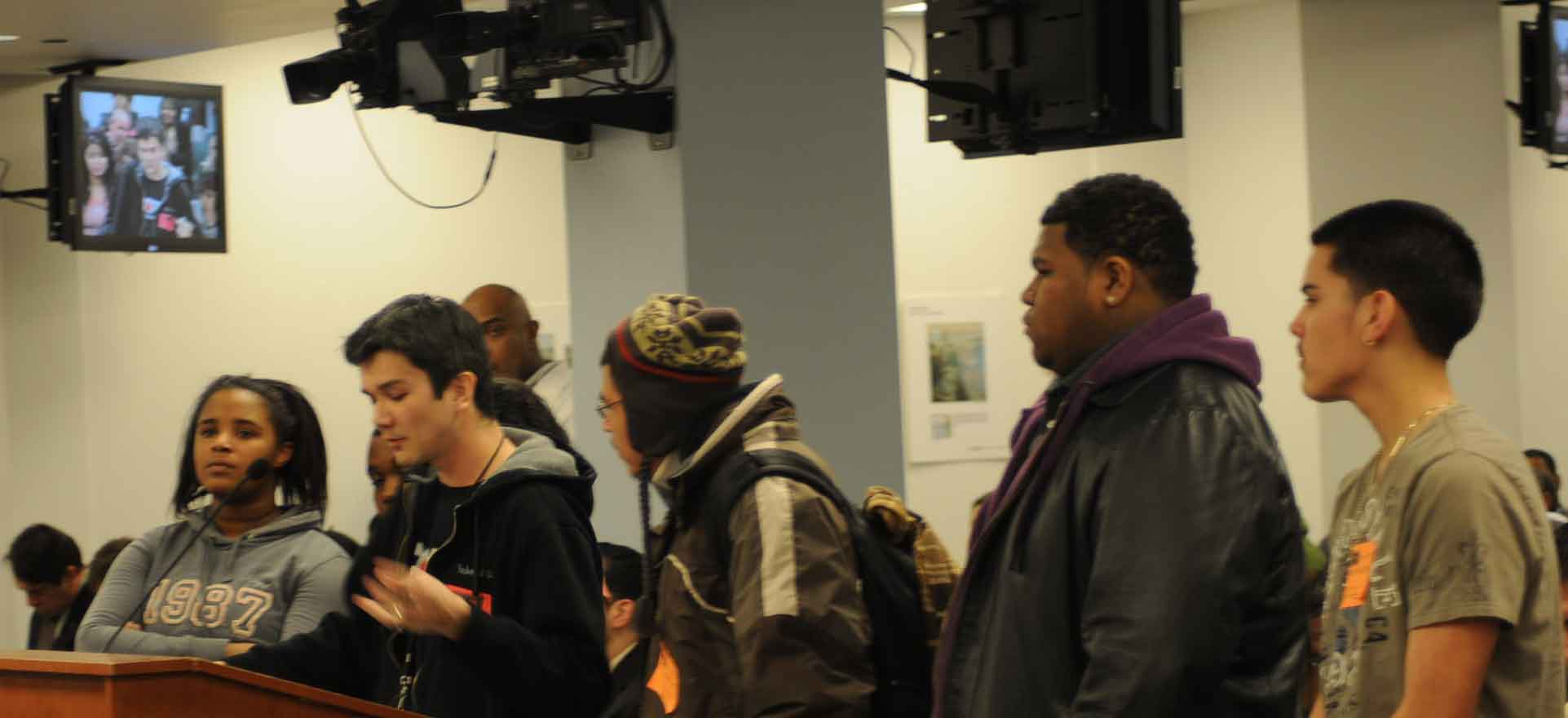 Xian Barrett testifying during public participation at the January 27, 2010 meeting of the Chicago Board of Education. Substance photo by George N. Schmidt.My name is Xian Barrett, Adult Ally of Chicago Youth Initiating Change, Teacher at Julian High School and a proud member of the CORE—the Caucus of Rank and File Educators in the Teachers’ Union.
Last year, at the DRIVE teachers’ meeting, I asked Mr. Huberman “Can’t you help us in the neighborhood schools, it seems like every support goes to the charters and new schools?”
Do you remember what you told me, Mr. Huberman? You said, “To tell you the truth, I’m more interested in improving the neighborhood schools.”
Since then, you have supported us at Julian High School, and we have improved and we thank you.
However, over the last several years, at the cost of countless lives and futures, you have learn what we already knew—that reform inflicted on communities doesn’t work.
Turnarounds don’t improve learning—your own research partners are telling you this. Charters don’t improve learning and they—in Chicago at least—exclude Special Education students and English Language Learners through non-testing measures—the UIC study and the CREDO study demonstrate this.
IDS (Instructional Delivery Systems) and forces PMs (Performance Management) don’t work—they are bloated and expensive and reform doesn’t happen by holding communities at gunpoint.
What works is the gift that you’ve given us at Julian—sufficient resources and power and agency for students, parents and teachers to be the change we know our community needs!
Now, I would be amiss if I didn’t mention that our Culinary Arts program is being cut at Julian. It’s currently being phased out to promote the program at Fenger Turnaround High School. Please give us the funding to continue this lifesaving program. Mr. Bell’s program takes in the students most likely to fall out of high school and teaches them the skills to succeed both professionally and academically.
Rather than holding seemingly hollow hearings to push “buy-in” to predetermined strategies, why not collaborate with every community? Let communities make our own choices about what our children need and support the programs that work.