'Your current reforms are not working...' Testimony at January 27, 2010 Chicago Board of Education meeting
Board Testimony 1/27/10. My name is Kristine Mayle and I’m proud to be a CPS teacher and a member of CORE. As you know, the Consortium on Chicago School Research released a study late last year that showed that there was no evidence to prove that Renaissance 2010 and all of its experiments made possible by mayoral control-reconstitutions, re-engineerings, closures, and charters have done anything to help the students of Chicago. The Consortium’s most recent work highlights what they call Five Fundamentals that do spur success in Chicago schools, and they have 15 years of data to back it up.
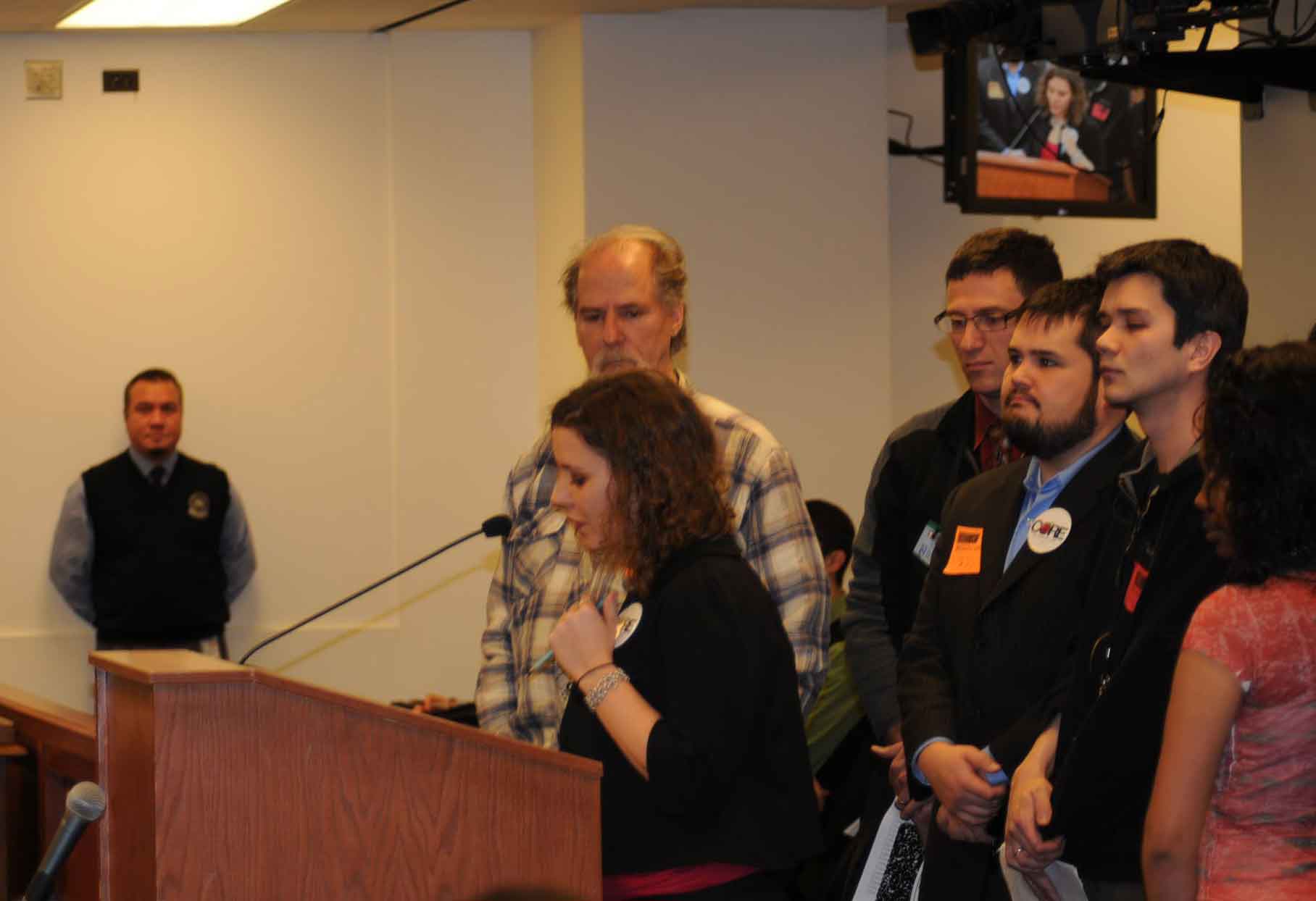 Kristine Mayle (above at microphone) speaks to the Board of Education on January 27, 2010. A few minutes earlier, Chicago Board of Education security, which had been doubled from previous meetings on orders of CEO Ron Huberman, had tried to block the CORE members and students accompanying Ms. Mayle from standing behind the podium in camera range. Huberman's decision to deploy double security at Board of Education meetings took more than a dozen experienced school security people off the streets and away from the schools the day after a Hubbard High School student was shot outside the school. Left to right behind Ms. Mayle (above): Earl Silbar; Jesse Sharkey; Kenzo Shibata; Xian Barrett. Substance photo by George N. Schmidt.These five things run counter to parts of the Education Department’s school improvement agenda, the things we’ve seen in CPS: charter schools, “innovation,” replacing principals with “New Leaders,” etc. The study shows that if the five factors are all in place, schools do improve.
These factors are:
1) Strong principal leadership that focuses on instruction and is inclusive of others in the work, as opposed to our current, top down leadership that dictates to principals instead of trusting them to lead.
2) A welcoming attitude toward parents and a formation of connections to communities.
3) Development of professional capacity—treating teachers like professionals and giving them good professional development and collaboration time.
4) A safe, welcoming, stimulating, and nurturing environment for all students. 5) Strong instructional guidance and materials, not forced curricula
When all five of these supports were working in tandem, the Consortium found that schools improved. In an article from “Ed Week,” Dr. Eason-Watkins was quoted as saying, “schools that adopted the model and the five fundamentals have improved.”
Dr. Watkins, as an educator, I implore you to stand up for our students and tell the members of the Board what we know is true: the current reforms aren’t working. Let’s adopt this Five Fundamentals model, which has been proven to help our students.